GUIDE 03 · BREAKDOWN · 6 min
Prop breakdown: how many stacks do you need to fill a briefcase?
The case is the prop. The stacks are the costume. You fill what the lens can see, and you stop when the lid still closes.
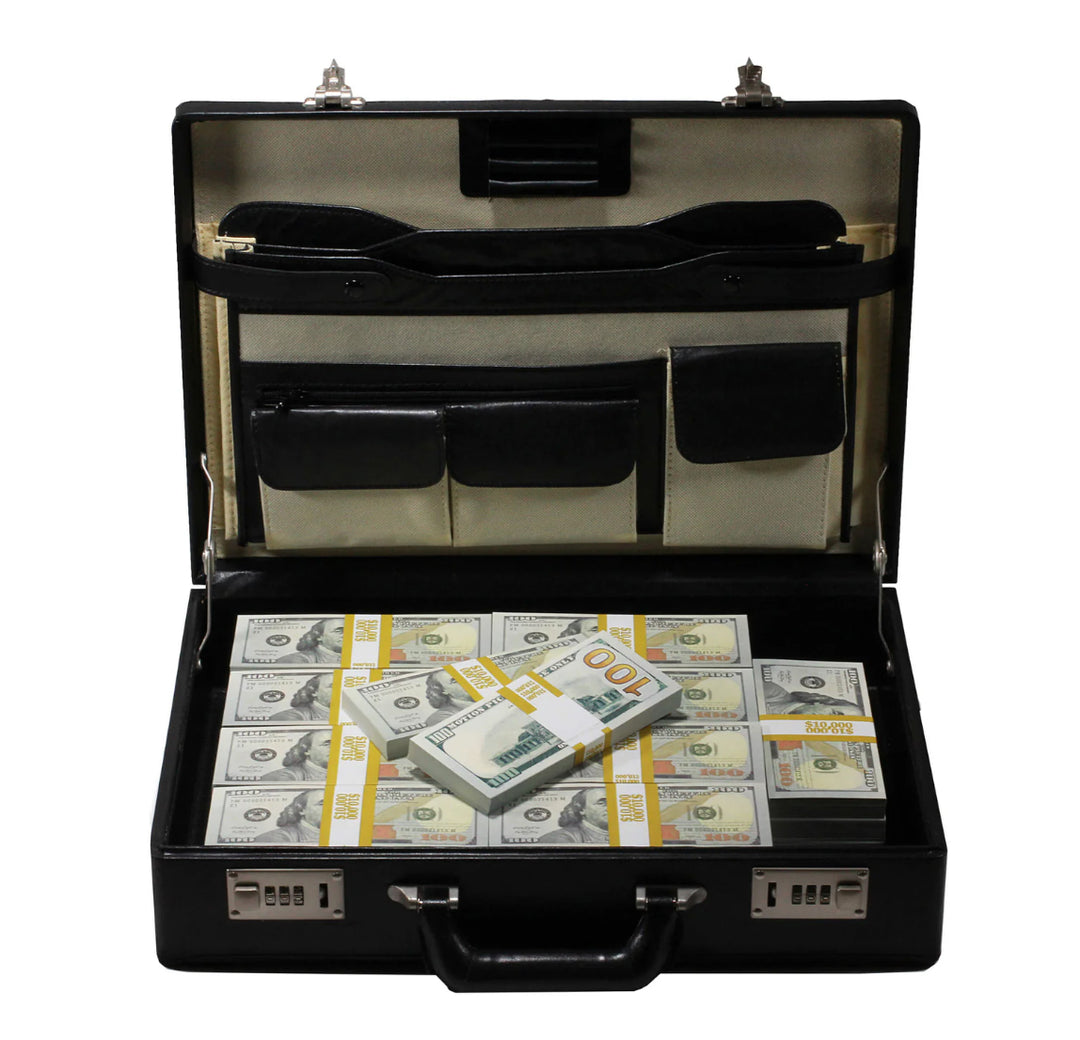
Productions over-order briefcases because they are counting dollars, not faces. The audience never audits the case. They see an open lid, two rows of straps, and whether the thing looks heavy when somebody lifts it. Here is the count that matches the picture.
Count faces, not a made-up million
An open briefcase shows the straps on top. A tight insert might see four of them. A walk-in wide might see eight, plus the lid. Everything under that layer is thickness. Blank filler is the correct thickness. Full print on every sheet in the case is how you buy a close-up you will never frame, and how a heavy case starts to look like a payroll error instead of a prop.
- Insert of a hand on the lid: 1 hero strap on top. Filler under it so the hand has something with weight.
- Open case, two rows, the shot you already know from the product photo: 4 to 8 full-print faces toward camera. The body of each brick can be filler.
- The walk-in, case closed until the click: you still dress the inside, because the next shot opens it. Same 4 to 8 faces. Do not wait until the lid is up to discover the case is hollow.
- A million-dollar wide is usually not this case. It is a duffel, a table, or a wall. One attaché case that is supposed to be a fortune reads as a fortune only if the story says so. The picture of a fortune is more paper than a lid can cover.
What the collection is already built as
CasaNarco does not make you invent the math from a ream of paper. The collection is sold as pictures. One strap is the insert. The $50,000 full-print bundle is a desk or a booth. The briefcase picture — $750K in stacks plus the silver case — is the walk-in. The aged million is the trailer wide, and yes, people also use that brick as a doorstop. The black case in the photos is the blank-filler briefcase: volume, straps, lid, done.
Dress the case like a prop, not a bank
Bands should sit square. A twisted strap is the first thing a 4K frame snitches on. Keep the hero bills clean enough to read as paper and handled enough to not look like they were unwrapped for the photo. If the story is tonight, use new series. If the story already happened, use aged. Do not mix them in one case unless the scene is about mixed money, and even then the hero row should agree with itself.
Leave the lid able to close. A case that cannot shut is a case that cannot do the walk-in, which is the shot you bought the case for. If the stacks mushroom over the rim, pull a layer. The wide will not miss it. The actor’s wrist will.
A buying list you can hand a producer
- One strap, if the shot never opens wider than a hand.
- The table bundle, if the case is only in the scene because the desk needed company.
- The briefcase picture, if someone has to carry it, open it, or drop it.
- The million, if the frame is a room. Not if the frame is a lap.
Write the number of cases and the number of straps on the call sheet. Count them back into the road case when you wrap. The breakdown is a camera problem right up until a strap leaves with a passenger. Then it is the other guide.
Not legal advice. Prop money is for film, television, photography, training, and media. It is not legal tender.